Disclosure: This article is based on official preview coverage and hands-on impressions shared by Digital Foundry at Gamescom 2025, where Nvidia hosted a dedicated press event showcasing Resident Evil Requiem running with full path tracing on PC. No payment was received from Nvidia, Capcom, or any affiliated party for this coverage.
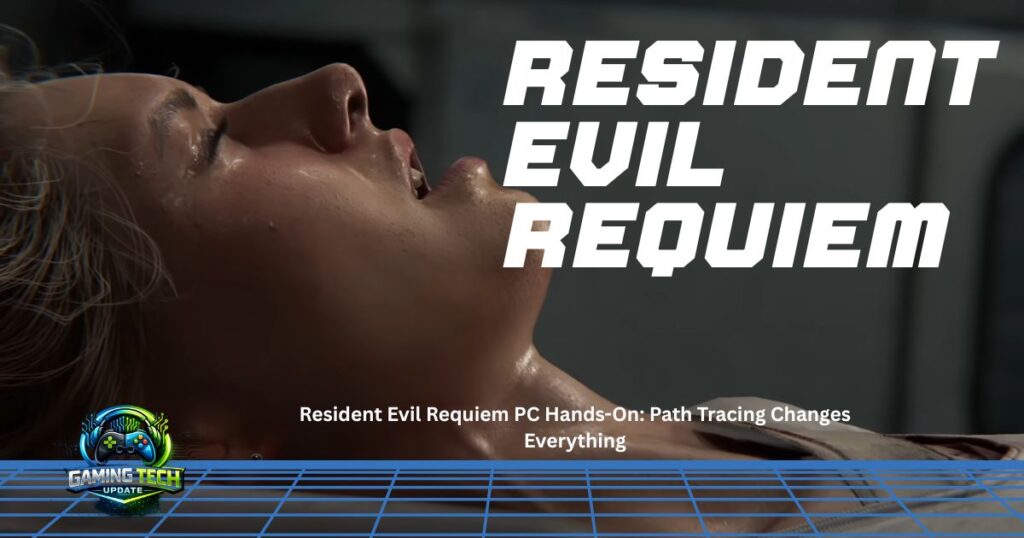
Resident Evil Requiem launches on February 27, 2026, and the PC version is already shaping up to be one of the most technically ambitious games Capcom has ever shipped. Why? Because it is the very first RE Engine game to support full path tracing on PC — and based on everything that came out of Gamescom 2025, it does not just add a shiny new graphics toggle. It fundamentally solves a set of visual problems that have followed the RE Engine since Resident Evil 2 Remake launched back in 2019.
- A Quick Note on the Source Material
- What the Demo Actually Shows You?
- The RE Engine's Long-Standing Visual Problems — And Why They Mattered
- What Path Tracing Actually Does in Resident Evil Requiem?
- The One Honest Caveat: Temporal Noise Is Visible
- Material Quality: The Benefit of Going Current-Gen Only
- First-Person vs Third-Person: Which Should You Actually Choose?
I have been following RE Engine’s technical evolution closely for years, and after digging deep into the Gamescom preview footage and detailed technical breakdowns, I want to walk you through exactly what is changing, why it matters, and what still needs work before launch day.
A Quick Note on the Source Material
Everything discussed in this article draws from official preview coverage filmed at Gamescom 2025, where press were given hands-on access to a playable demo of Resident Evil Requiem. The demo was shown running on Nvidia hardware at an Nvidia-hosted event, which explains the focus on path tracing and DLSS Ray Reconstruction. The game is still in development, so some of what was observed may change before February 27, 2026.
With that framing clear — let’s get into it.
What the Demo Actually Shows You?
The Gamescom demo places you in control of Grace, Requiem’s new protagonist, inside a mid-century styled building that is almost entirely unlit except for whatever light sources you interact with or carry on your person. Right from the opening screen, you are given a choice: first-person or third-person perspective. The developers themselves recommend first-person for your first playthrough, and watching preview footage in both modes, that recommendation makes complete sense — first-person heightens the claustrophobic tension in a way that feels deliberately engineered for horror.
The gameplay shown in this slice is puzzle-forward and stealth-heavy. You are being hunted by a creature through dark corridors, armed with not much more than your wits, a lighter, and the ability to throw bottles to create distractions. There is very little direct combat on display here. The overall feel drew immediate comparisons to Alien: Isolation — that specific breed of horror where survival means avoidance, not aggression. It also carries a strong PT energy: dark hallways, a relentless pursuer, puzzles woven into the environment. Whether the full game expands into more action-oriented territory remains to be seen, but the foundation is genuinely unnerving in the best way.
The RE Engine’s Long-Standing Visual Problems — And Why They Mattered
To understand why Requiem’s path tracing is such a big deal, you need to know what RE Engine games have historically struggled with on a technical level. This is not just nitpicking — these were real, visible issues that affected immersion.
| Visual Problem | Which Games Were Affected | How Noticeable Was It? |
|---|---|---|
| Noisy, broken Screen Space Reflections (SSR) | RE2 Remake, RE3, RE8 Village | Very — reflective floors and puddles would shimmer and break apart constantly |
| Raised black levels in dark areas | RE2 Remake especially | Extremely — dark rooms appeared grey rather than black, killing horror atmosphere |
| Flat, unconvincing Ambient Occlusion (SSAO) | Most RE Engine titles | Moderate — contact shadows lacked depth, making scenes feel less grounded |
| Blocky or heavily stippled shadows | RE2, RE3, RE7 on certain settings | Noticeable — shadow edges often looked unrealistic or overly harsh |
| Transparent materials lacking proper reflections | All prior RE Engine games | Moderate — glass panes simply did not reflect the scene around them accurately |
These were not catastrophic failures — RE Engine games still looked excellent by most standards. But for players who push PC settings to the maximum and care about physical accuracy in rendering, these shortcomings were consistently frustrating. Path tracing, done properly, addresses every single row in that table simultaneously.
What Path Tracing Actually Does in Resident Evil Requiem?
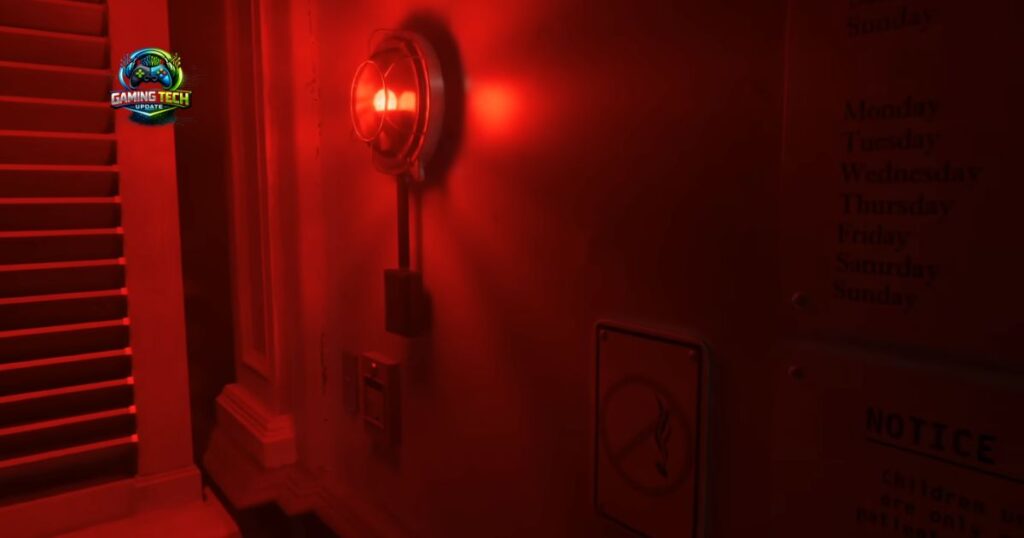
This is where things get genuinely exciting from a technical standpoint, so let me break it down piece by piece rather than just saying “it looks great.”
Direct Lighting Is Now Fully Ray Traced
In previous RE Engine games, direct light sources used rasterized shadow maps — a well-established but fundamentally approximated technique that produces the blocky, stippled shadow edges the engine became known for. In Requiem, direct lighting is fully ray traced. Every light source in the scene casts shadows through actual ray calculations, which means shadow edges are physically accurate and scale correctly based on the distance between the light, the object casting the shadow, and the surface receiving it.
The lighter that Grace carries around the demo is the showpiece for this. The moment you flip it open, the entire scene reacts — every object within range casts a soft, accurate shadow that moves correctly as you move. Interactive lamps scattered throughout the environment have the same effect. It sounds simple, but seeing it in motion is a completely different experience from any previous RE Engine game.
Reflections on Transparent Materials — A First for RE Engine
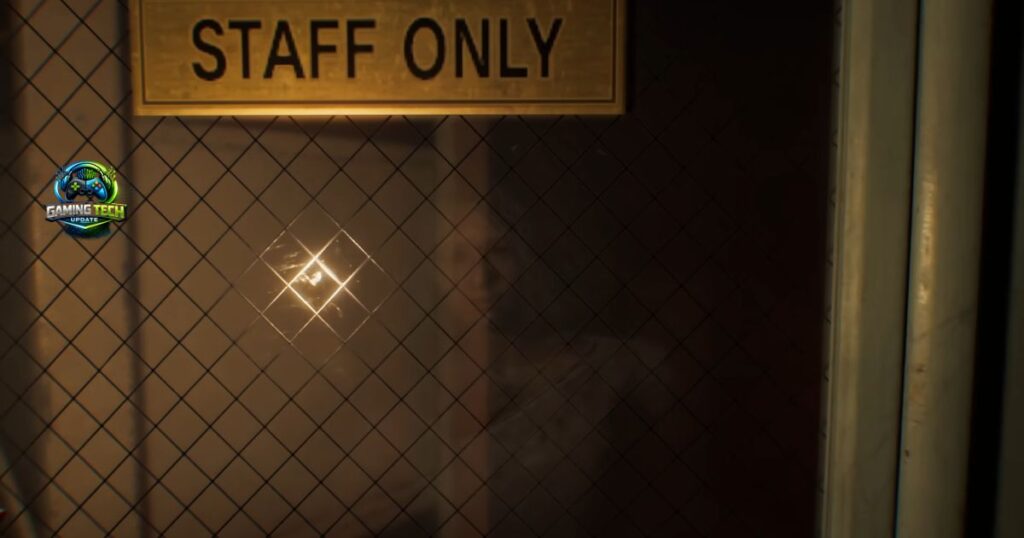
One of the most technically impressive details in the preview footage involves transparent surfaces. Standard ray tracing implementations — even good ones — typically skip reflections on transparent geometry because of the additional computational cost involved. In Requiem, panes of glass correctly reflect the surrounding scene, and they do so in a way that looks convincing rather than approximate.
There is also strong evidence that path traced transparency may be at work in some of the light fixture glass visible in the demo — semi-transparent bulb casings that scatter light in a soft, diffuse way that would be very difficult to fake convincingly in screen space. A similar technique was added to Alan Wake 2 as an ultra-quality update via patch, and Requiem appears to be following that same path. Whether it is confirmed as full path traced transparency before launch is still an open question, but what is visible in the preview footage looks exceptional.
The End of Raised Black Levels
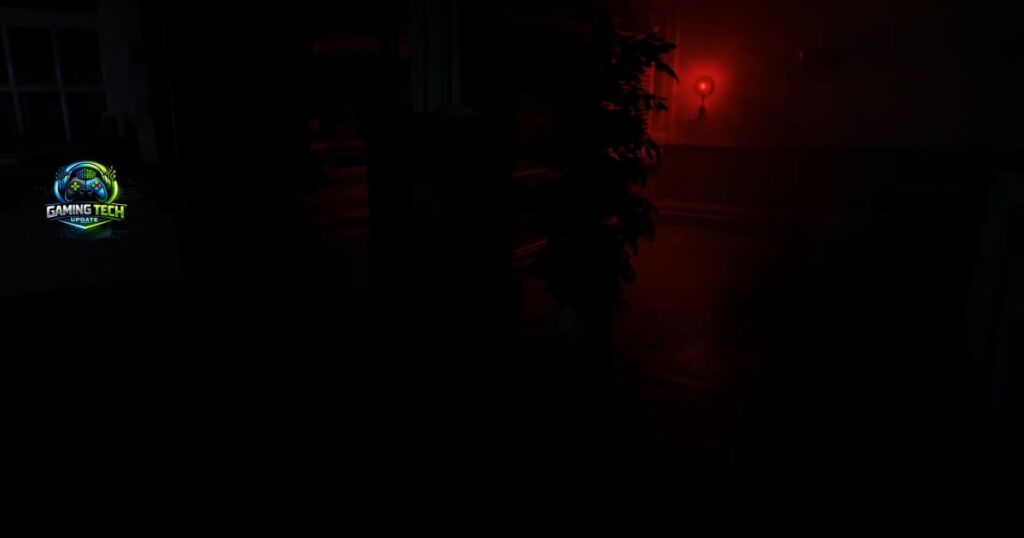
This is the fix that I think will matter most to people who play these games for atmosphere. RE2 Remake was particularly notorious for raised black levels — areas that should have been genuinely, purely dark instead rendered as a murky grey, which completely undermined the horror aesthetic the game was going for.
In Requiem, the preview footage captured on OLED displays shows absolute black in unlit areas, with only the physically accurate bounce light from distant sources providing any illumination. The game is fully committing to darkness rather than hedging against poor LCD black level performance. That is a bold design choice, and on the right display — particularly an OLED — it reportedly looks stunning. On the LCD laptop used during the event, backlight bleed partially softened that effect, which is worth knowing if you are playing on a standard non-OLED panel.
The One Honest Caveat: Temporal Noise Is Visible
I want to be straight with you about something the preview coverage flagged clearly, because glossing over it would not be doing you any favors.
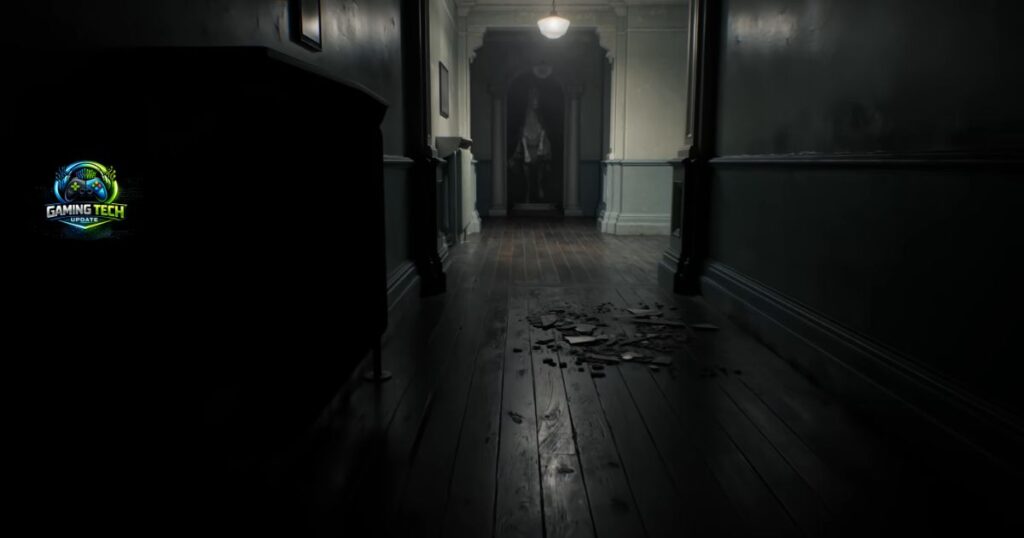
In the darker areas of the demo — particularly where indirect light was leaking subtly around surfaces — there was visible noise and jittering in the path traced result. Not the kind of catastrophic flickering you might have seen in some early path traced games, but a definite swimming quality in areas that should have been completely static. It is the kind of thing that, once you notice it, you cannot entirely un-notice.
I want to be straight with you about something the preview coverage flagged clearly, because glossing over it would not be doing you any favors.
In the darker areas of the demo — particularly where indirect light was leaking subtly around surfaces — there was visible noise and jittering in the path traced result. Not the kind of catastrophic flickering you might have seen in some early path traced games, but a definite swimming quality in areas that should have been completely static. It is the kind of thing that, once you notice it, you cannot entirely un-notice.
This is a known challenge with path traced indirect lighting, and it is compounded here by DLSS Ray Reconstruction, which has historically struggled with temporal stability in very dark, indirectly lit scenes — particularly in early implementations. The persistent depth-of-field effect running throughout the demo may also be complicating Ray Reconstruction’s ability to cleanly resolve those regions.
The critical thing to remember is that this is a game still in development, observed at a press event months before its February 27 release date. It is entirely plausible — even likely — that this gets tightened up before launch. And even if it does not improve dramatically, the overall visual quality is so high that this reads as a blemish rather than a dealbreaker.
Material Quality: The Benefit of Going Current-Gen Only
Path tracing gets most of the attention in the preview coverage, and rightfully so. But there is a parallel story here about raw asset quality that is worth talking about separately.
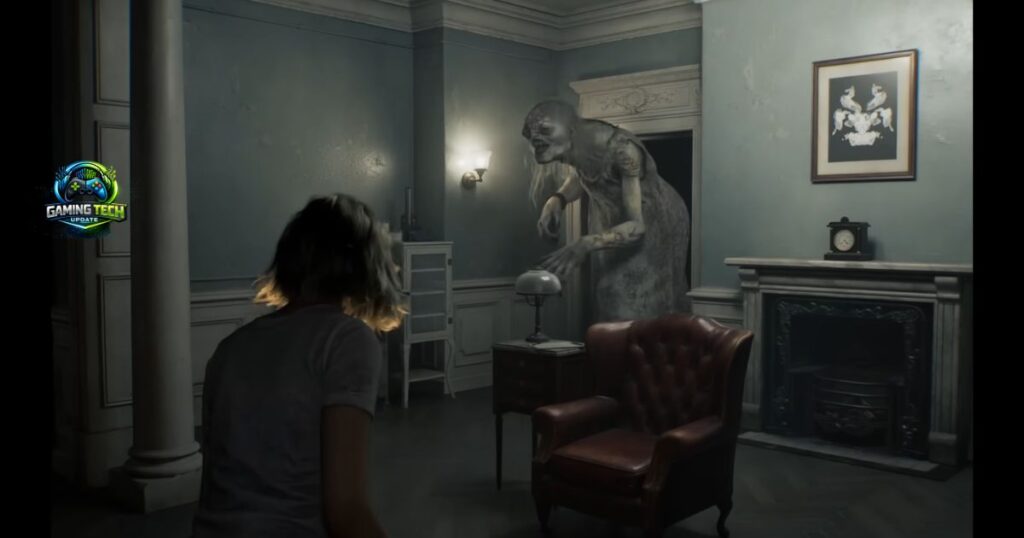
The material work visible in the Gamescom demo is, by consensus from everyone who played it, the best seen in any RE Engine game to date. Stone surfaces, wooden furniture, semi-matte plaster walls that take on a gloss at grazing angles, small decorative statues — every surface in the environment appears to have been built to a standard that previous Capcom titles simply could not match.
The reason is straightforward and significant: Resident Evil Requiem is the first game in the mainline RE Engine series that was not designed around last-generation hardware constraints. Every previous entry — even the more recent ones — had to keep PS4 and Xbox One specifications in mind at some level during development. Requiem does not carry that limitation. That means higher texture resolution, denser geometry budgets, and character models that can be genuinely detailed rather than carefully optimized for older hardware.
The character animation work also benefits directly from this. Because Requiem supports both first-person and third-person play simultaneously, Grace’s full third-person animations had to be built to a high standard — and you actually get to appreciate them even in first-person mode, because mirrors and reflective surfaces around the environment show her full model reacting to the scene. Watching Grace’s character model cower with fear while looking at a ray traced mirror reflection was, by all accounts, a genuinely impressive moment that showed off both animation quality and visual fidelity at the same time.
First-Person vs Third-Person: Which Should You Actually Choose?
The game’s own recommendation is first-person for your initial run, and based on everything I’ve seen from the preview footage, that advice holds up. The first-person mode heightens tension in a way that feels deliberately engineered — being stalked through dark corridors with no weapon and limited visibility is considerably more frightening when you cannot see the space around your own character.
That said, third-person is far from a lesser experience. The camera work and environmental design clearly support both modes, and third-person gives you a much richer appreciation for how Grace moves, how the lighting interacts with her character model, and how the animations read within the physical space of each room. If you are someone who plays these games with a strong eye on visual presentation, third-person might actually serve you better on a second playthrough.